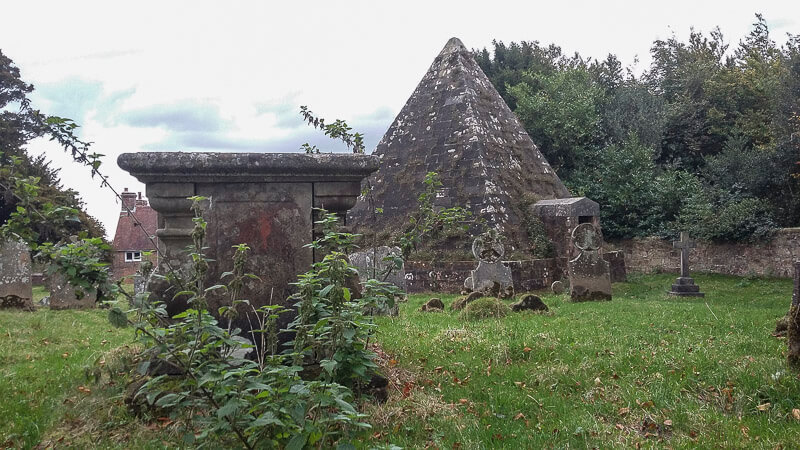
We were contracted to do some restoration work to Jack Fuller’s mausoleum.
The works involved, deep pointing, replacement of sandstone blocks, removal and reconstruction of unstable areas.
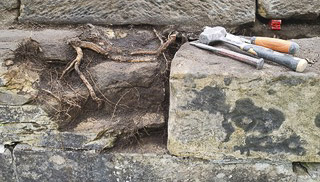
The first thing was to remove all foliage, this was treated with a professional weed killer, ensuring they were dealt with into the root system deep into the stonework.
Next was to erect the scaffolding to enable access.
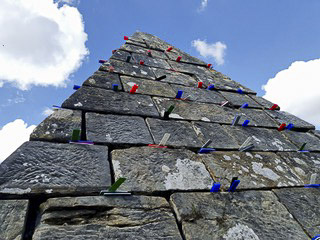
It was decided to start at the top, due to the angle of the pyramid, as we cut out the debris and soil, it would the roll down out of the way, to be cleared on the way down.
Cutting out, the old sand and cement pointing, (from the 80s restoration works) this was around 20 to 25mm deep, with the rest of the bed joint consisting of dust and dirt.
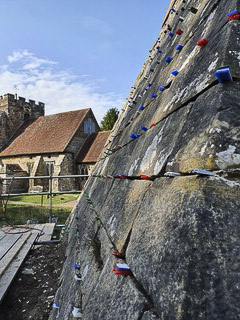
On cutting out, we would, remove the pointing from the corners of the sandstone blocks first, these would then be supported by our temporary packers, when secure, the rest of the joint would be removed, this kept everything stable and in position.
In order to deep point we had to remove all debris to the depth of the sandstone blocks, these being around 6 to 7 inches deep on the sloping areas.

The pointing process was conducted in two parts, deep fill and top fill.
We would deep fill halfway and leave this for a day or two, then we would compact it with our custom-made metal plates or timber of different thicknesses to suit the joint.
The top fill could then be applied, this was left to cure and again compacted to reduce the shrinkage.

Areas of reconstruction, this particular area had dropped in, as the plinth has slipped out, making it impossible for us to rebuild the plinth as it should be.
It gave us our first observation of construction, the infill is made up of lime mortar and sandstone hardcore a very strong, stable mix.

Plinth
The plinth is made up of very large blocks, the top row being the largest of 18/20 inches in depth, it is the back edge of the top row that supports the pyramid shape on top of the square plinth. Structurally the top row and second row are doing most of the work supporting the stone blocks above all the way to the top.
The N /E plinth was the worst affected, having slipped out 4 inches, all the way down to just above ground level.

Covering up
The shape of the pyramid was probably one of the hardest things to deal with when trying to cover up in case of rain or frost, a vertical wall is easily covered and a minimal amount of rain will run down it, we had 8mts of stone stretching towards the heavens at approximately 60 degrees incline, any rain hitting it would then be propelled down the slope washing out any new pointing until it hit the plinth where it would then saturate the lower stone blocks.

Once a side had been completed, with all pointing compacted and bashed with a stiff dairy brush, we could then cover up. A timber frame was constructed with three layers of hessian fixed over the top, which is used for frost protection, then an additional frame giving an air gap to ensure good ventilation, this was then covered by a heavy gauge polythene used in the building industry, (this is made from recycled plastic) this sheet kept the wet out, a gap was kept at the top for ventilation.
Pointing was supplied ready to go, just needed to whisk it up into a workable form, setting time was advised to be around 3 months dependent on temperature and weather conditions, so keeping it protected over the winter months was important.
We used 6 tones of lime mortar in the pointing and restoration works.
On uncovering in the spring, some of the mortar was still unset, these were the last areas to be done and were also on the lower plinth that was still saturated.
Couple of weeks in the air, temperatures were up after a long cold North Easterly spring and the last of the pointing started to set.
Lime mortar is not a chemical set like that of cement, but a process of absorbing carbon dioxide, (Carbonisation) to form CaCO3 crystals.


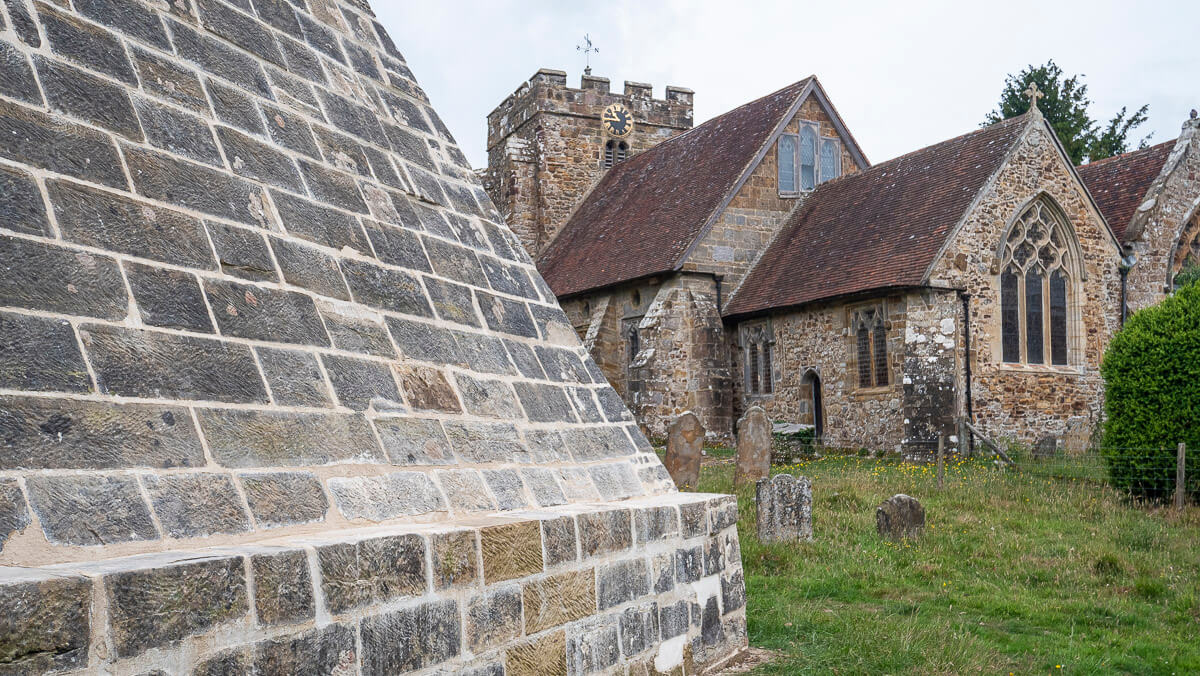


Jack Fuller’s Pyramid Brightling
Jack Fuller’s Pyramid is located at St Thomas a Beckett church in Brightling East Sussex. It is 8m high and dominates the churchyard.
Jack Fuller was a larger-than-life local character. A wealthy man and MP for the local area 1780-1812. He built many follies around the Brightling area including his own mausoleum: the Brightling Pyramid.
The pyramid was built in 1811 of Sussex sandstone and is 25ft square and 25ft (8m approx) high.
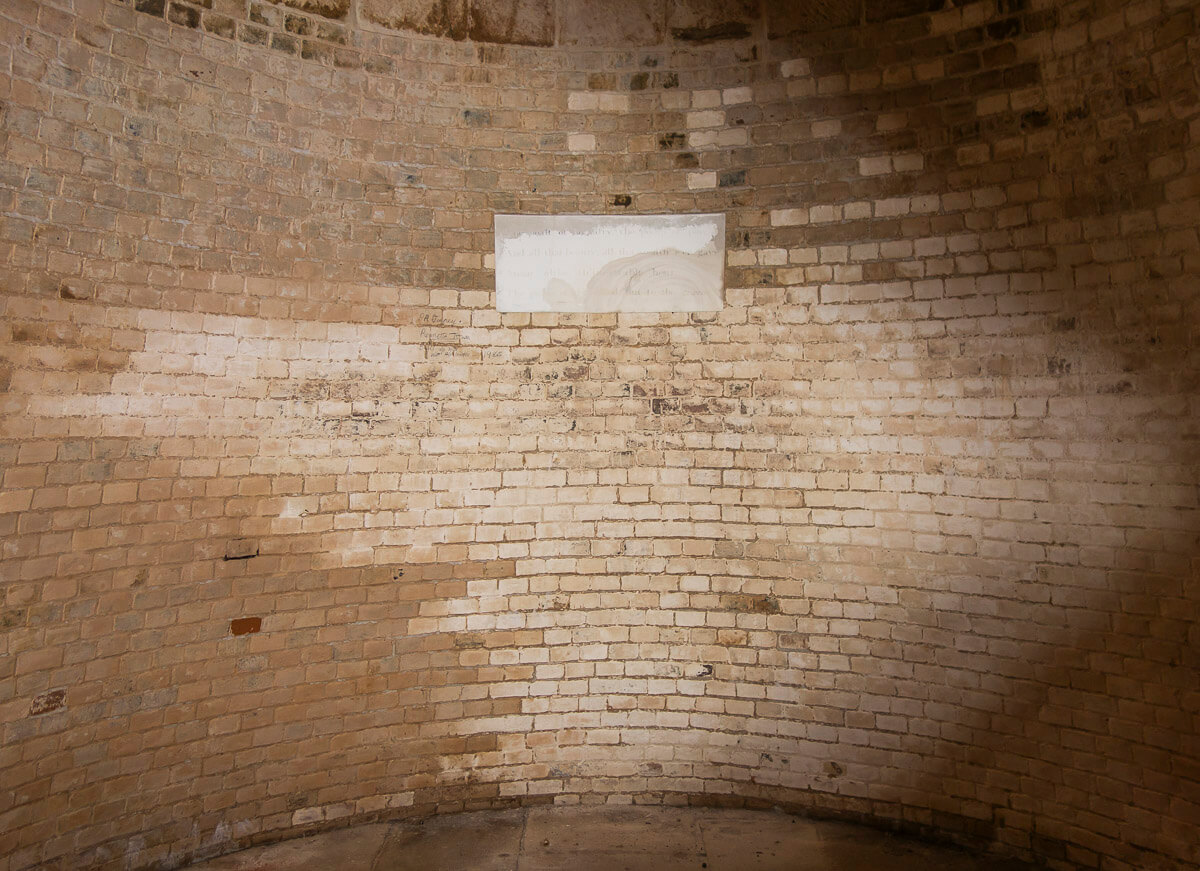
The stone plaque inside reads:
“The boast of heraldry, the pomp of power,
And all that beauty, all that wealth e’er gave,
Await alike th’inevitable hour;
The paths of glory lead but to the grave.”
When Jack Fuller died in 1834 he was buried beneath the Pyramid.